The Limits of AI-Driven Allocation: Optimal Screening under Aleatoric Uncertainty
Santiago Cortés-Gómez*, Mateo Dulce Rubio*, Carlos Patiño, Bryan Wilder
Abstract
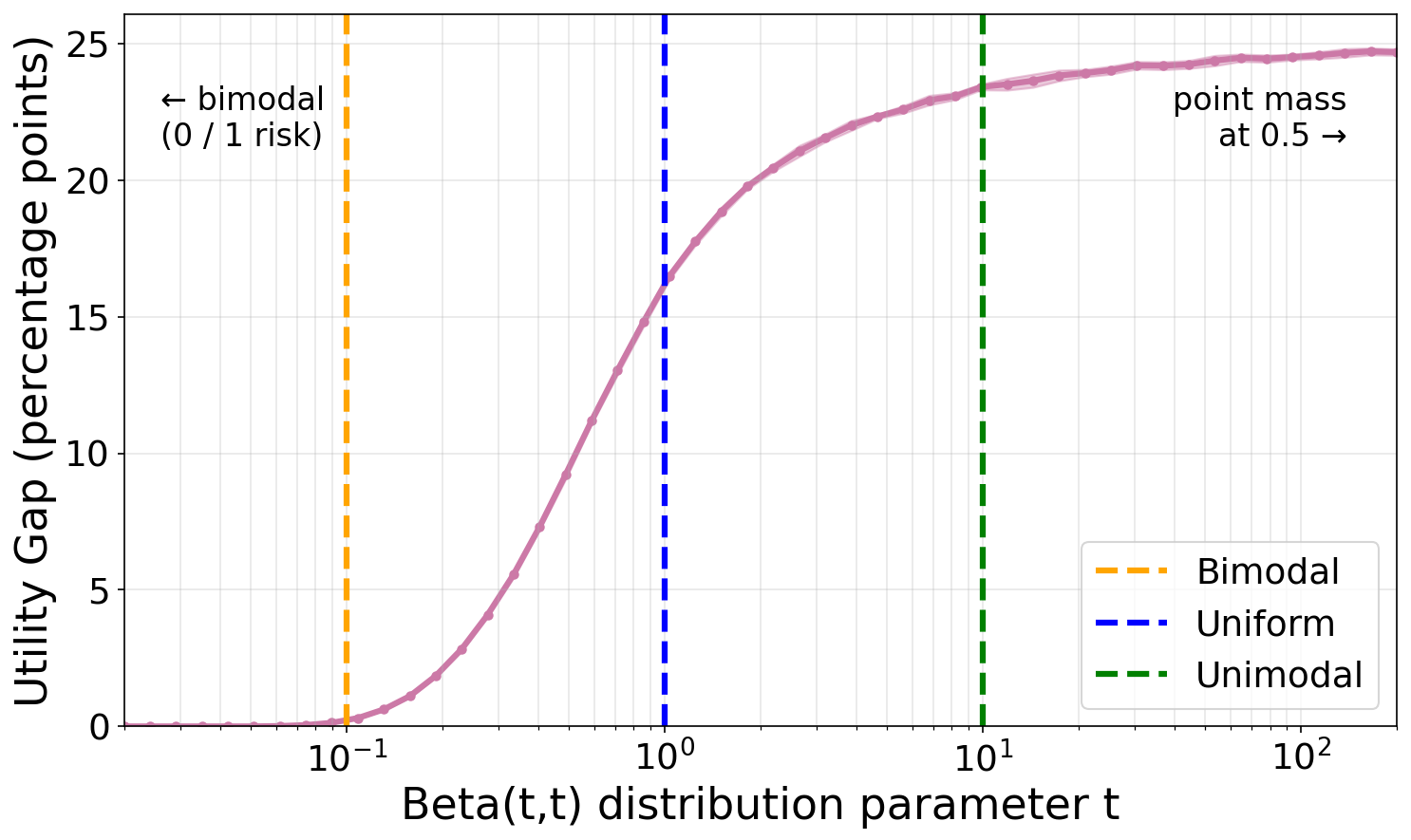
The rise of machine learning has shifted targeted resource allocation in policy and humanitarian settings toward algorithmic targeting based on predicted risk scores. This approach is typically cheaper and faster than traditional screening procedures that directly observe the latent vulnerability status through physical verification. Yet, even access to the true conditional vulnerability probability cannot eliminate misallocation: aleatoric uncertainty over individual vulnerability status is irreducible, and probabilistic targeting inevitably misallocates some resources. In this work, we study how screening and algorithmic targeting should be optimally combined in a two-stage allocation framework, in which a screening stage observes true outcomes for a subset of units before a final allocation stage assigns the resource under a fixed coverage budget. We show that the optimal strategy screens units at the margin of algorithmic allocation, while directly targeting the highestrisk units. We empirically characterize when screening and algorithmic targeting act as complements or substitutes: efficiency gains from screening grow as the aleatoric uncertainty in the population increases. Finally, we characterize the relative value of screening and direct allocation, which yields a simple rule for splitting a program budget between the two: the optimal cutoff depends only on their cost ratio. We illustrate our framework with applications in income-based social protection programs and humanitarian demining in Colombia, where the tension between screening costs and allocation efficiency is operationally consequential.
Reference
The Limits of AI-Driven Allocation: Optimal Screening under Aleatoric Uncertainty
Santiago Cortés-Gómez*,
Mateo Dulce Rubio*,
Carlos Patiño,
Bryan Wilder
Neural Information Processing Systems (NeurIPS). 2026.
PDF